
Game Theory, The Guys You Need*, and Swaps
Good morning. It is September 1st (as of writing this), and it’s the last day we won’t have a Battle Royale tournament to draft in the Underdog lobby. I am beyond excited to start drafting and theorizing how to best play these. In this post I’ll review the (varying) contest structure, the dynamics of drafting that come with it, and how to leverage the rules of player swaps in your favor.
Basic Contest Structure – what is a “Battle Royale”?
Battle Royales are Underdog’s DFS offering for all sports. The NFL “main slate” features a six round, six person draft lobby. It is quite the shock to go from drafting 216 players per draft to only 36 in the blink of an eye. For NFL BRs, you’re drafting 1 QB, 1 RB, 2 WR, 1 TE, 1 Flex. It is half-PPR, the same scoring settings as BBM. Due to this, touchdowns are disproportionally valuable for these contests. The problem of course is that touchdowns are random! This is why we play the game baby. We will use our knowledge of what creates value in fantasy football to make our decisions in these contests, along with a little game theory.
Back to the contests – so, you complete a draft with five others. You are not just competing with your fellow drafters in said lobby. These drafts are pooled into one big tournament for the week along with the tens of thousands of other drafts that take place for the slate. It lends itself to being advantageous for the volume player as it gives you more opportunity to find yourself in a unique room with falling value or getting a hard to draft stack. This doesn’t mean it’s impossible to win if you’re not drafting 20+ teams, but it’s certainly enticing to so (as it always is in DFS).
One of the last wrinkles to add to this is that we cannot draft six players from one team. Your team will be forced to draft at a minimum one player from a different team. Not that drafting five players from one team is advantageous, but simply outlining a rule that exists across the board.
Base Strategy Points
One of the original game theory levers in DFS is uniqueness. Last season, we saw manifest in a number of ways, but on the whole it was the year of the Chalk Donkey last season. In the Battle Royale streets, “chalk” represents such a small percentage of the total player pool as we’re only drafting 36 players a lobby. That is a fraction of the player pool in your typical 13-game slate. When we say on Badge Bros to “scroll the F down”, that doesn’t necessarily mean:
- Waiting until round six to scroll
- Scrolling well past the ADP of 30
- Avoiding the top10 in ADP
- Taking an extremely low floor player
While you can have success doing one or some combination of the above, it can be as simple as taking Raheem Mostert (35.3 ADP) and Deebo Samuel (35.4) on the same team in the main slate this week. This is not a huge sacrifice if you consider their range of outcomes vs their peers! So scroll down, but don’t go down the rabbit hole too far. Or do it, be my guest. Point being, it is very easy to get unique in BRs without sacrificing too many projected points.
Correlation City
We love to correlate on Underdog. An entire summer of drafting for one season of football has been completely hijacked over the idea of correlating for Week 17. We’re stacking to the nth degree and running those stacks back with even more stacks in best ball. Which raises an important question: how important is stacking in Battle Royales? To help gauge this, Lex Miraglia posted a quick thread on what we saw take down BRs the last two seasons. Obvious caveat of small samples apply to this, but it’s worth reviewing.
Evidence/data aside, I believe that common sense will lead you toward an answer to this question of “it depends, but most often, we do not want to over-correlate.” One of the major guard rails I am applying to my drafts based on this logic is to only attribute a very small portion of my portfolio to stacks greater than 3 players per game. I don’t like to say never here, because there are many circumstances where it can make sense, such as a game stack being overlooked by the field that presents strong upside, or a sizable ADP value falls to me.
Player Selection (who, how often, when?)
Here comes to the fun part. Telling you exactly who to draft and how to win these very fun but very challenging tournaments. While I seem to have misplaced my crystal ball, I do have banners hanging from 2022 from the 12-person contest “Goal Line Stand”.

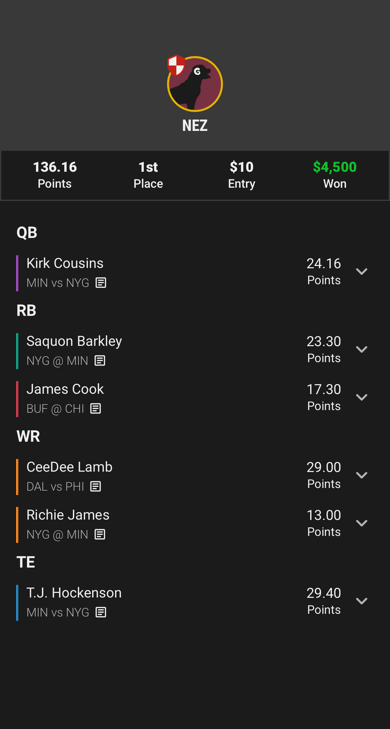
It appears T.J. Hockenson and CeeDee Lamb are nice to have. Good to know!
One commonality from these two weeks/lineups was the identifying of game environments. Lions vs Seahawks in Week 4 (Amon-Ra St. Brown ruled out on Sunday), and Vikings vs Giants in Week 16. In Week 4, I entered the Goal Line Stand for the first time that week after St. Brown was ruled out, and the lobby either 1) had no faith in the Lions that week or 2) was slow to adjust to the news due to the timing. However, you don’t need to wait until Sunday to capitalize on late breaking news. You can play these situations both ways – by taking a player who is truly Questionable and utilizing the auto-swap to replace them if they are out, or by anticipating it before the lobbies have time to react and adjust to the news and drafting the beneficiaries ahead of time. Let’s focus on swaps for a moment.
Underdog I believe will provide clarification on important swap questions soon (I volunteer to help deliver the messaging to the users by the way, DMs are open), because there’s a lot of nuance that goes into swaps for BR. Without getting too far off course, Underdog will swap out any player ruled OUT in your lineup, providing they were not already ruled OUT or DOUBTFUL when you drafted them (if you are at risk of drafting someone who is not swap eligible, you will receive a notification telling you so). The player that is swapped in depends on your rankings (personal or default), who was/wasn’t drafted in that specific lobby, and who else in your lobby requires a player swap. I’ll leave you on a cliff hanger on the details of swap run for now, because like I said, there are no details of this in the rules.
As far as how much of one player you should take, that is something that is fully in your control, and no right or wrong answer to. It is up to you to decide what your bankroll is for the season/the given week, and make the best decisions you can that align to those goals. The concentration of a given player will also always depend on the context of ADP that week. The important takeaway here is that we understand the risk/reward of our portfolios and we don’t make any assumptions that put us in uncomfortable territory.
Lastly, what do we do about the chalk? One of the most unique things about BRs is that the chalk is not the same as it is on traditional redacted DFS platforms. There’s no salary component to our game, just draft capital spent. We have access to every player at some point throughout our drafts. This can be overwhelming for drafters as they feel obligated to adhere to ADP. Can I really pass up on (WR9) to draft (WR15)? The answer is obviously, of course you can. The chalk in BRs can be loosely identified as the first ~30 picks in ADP. Once you get past pick 30, the frequency that these players are selected is difficult to estimate. It’s helpful for us though to know that regardless of their exact % drafted, the app itself is telling us who is going under-owned. This is valuable information when you combine an under-drafted player on Underdog with the qualities of DFS chalk. These players become great picks for us.
This where I’m going to conclude this post. For the rest of the season, you can expect some form of weekly Take Sheet for the NFL. This week I will be joining the Ship Chasers in Vegas, so a post for Week 1 is TBD.
I hope you found this useful as someone new to the BR streets or even a seasoned veteran. I look forward to reviewing lineups and battling it out with you all this season. Best of luck! Until next time.
Nez
 Take Sheet